Arrow Films’ release of Eaten Alive is introduced (as part of the extras package) by helmer and Texas Chain Saw Massacre maestro Tobe Hooper, as a parting shout he exclaims “Hope you like the colours!”
Hmm, it starts very shakily and in the space of 11 minutes a woman escapes from a brothel and winds up at a fleapit motel (all clearly set on a studio lot). Two men try to rape her (including a young Robert Englund), she is forked to death (no pun intended) and thrown to a swamp-dwelling creature which could be a crocodile or alligator; locals are unsure. I wish I could tell you it gets better… even though it was adapted by Kim Henkel, Texas Chain Saw Massacre this is not.
All characters stumble upon Judd’s grotty Starlight Hotel with its dirty damp patches and soiled walls – believe when I tell you, you’d rather sleep in your car. Judd (Neville Brand)is a loner Patriot, guns (and American flag) adorn most walls, there’s even a swastika flag draped on a chair. Judd isn’t the type of man to leave you alone, he has a pet alligator and leers suggestively at any and all females that pass through. He’s a misogynist who even takes delight at terrorising a small calliper-wearing (female) child. That said every character is practically irredeemable; child and ‘gator aside. From an unrecognisable Carolyn Jones as brothel owner Hattie, via rugged ‘cowboy’ Sheriff (Stuart Whitman), to arguably the greatest Final Girl Marilyn Burns as Faye who sadly spends most of the film with her mouth taped shut. The filters used create an artificiality, which given the setting makes perfect sense and does add to the whole surreal B-movie effect. Garish reds and blues distort images and there’s a lot of eerie, atmospheric mist over the swamp; in keeping with the red, white, and blue of the flag.
Okay, so dig a little deeper and there are indications of an ideology, the film is playing to affirm and just like Hooper’s earlier work, the family is at the centre but the problem is Eaten Alive – or as it is otherwise known Death Trap – isn’t very good; it’s disjointed and a little exploitative particularly in its scopophilia. There is some inexplicable make-up work and a foray of (dodgy) women’s wigs which further aid the ridiculous.
So yes Tobe, can’t say I enjoyed the film greatly but I liked the colours.
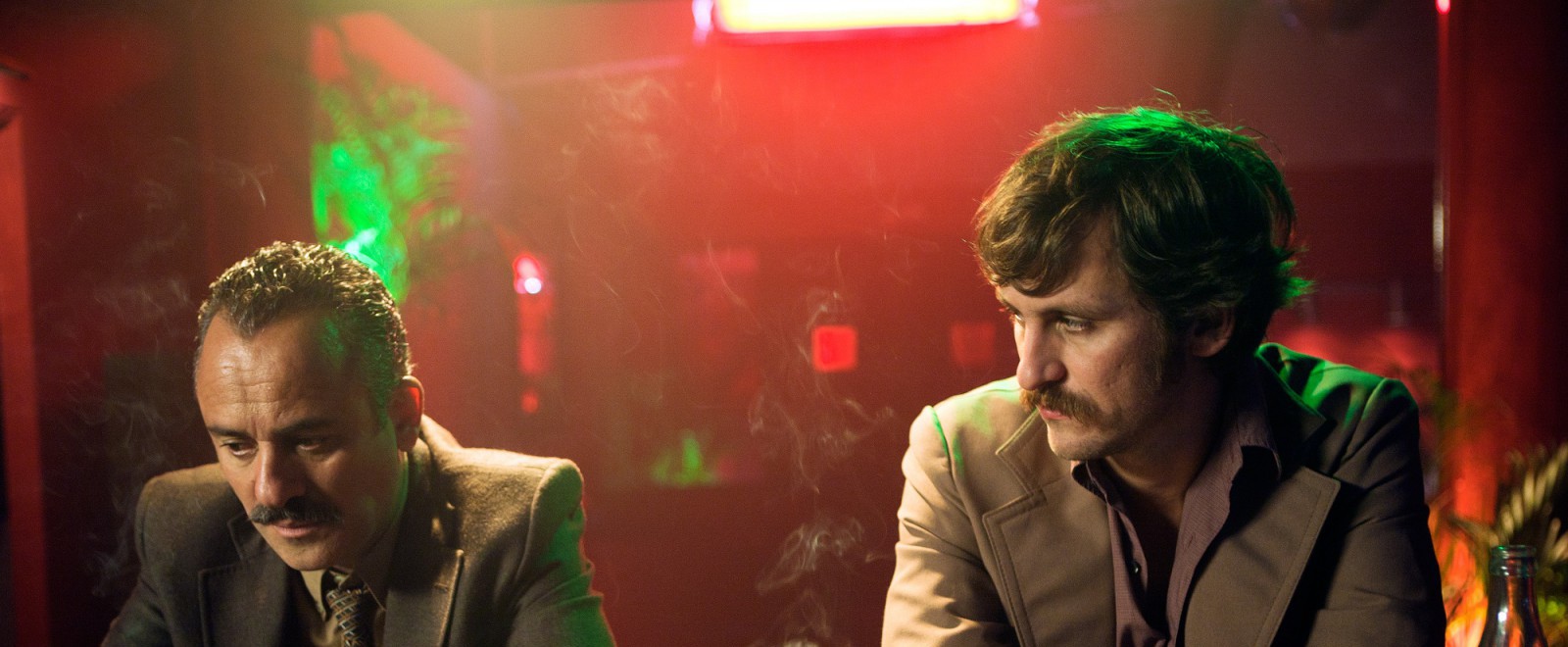
Alberto Rodríguez’s Marshland [La isla minima] opens in 1980 Andalucía. Times are a-changing as the fascist regime has come to an end and a democratic genesis is taking baby-steps in moving the country out of political turmoil. Detectives Juan (Javier Gutiérrez) and Pedro (Raúl Arévalo) are called in from Madrid to investigate the disappearance of sisters Estrella and Carmen. Both men are out of their comfort zone in Guadalquivir marshland and aside from their employment and respective facial hair, they appear to have little in common and each personifies the changes of the political climate (and not always in the ways one would think). This personality clash adds to the tension, especially when the girls are eventually found, sexually assaulted, tortured; their mutilated bodies left in a ditch, and so begins the ambiguous crossing of lines between cop and hunted. Both determined to catch a murderer and prevent more killings by any means necessary.
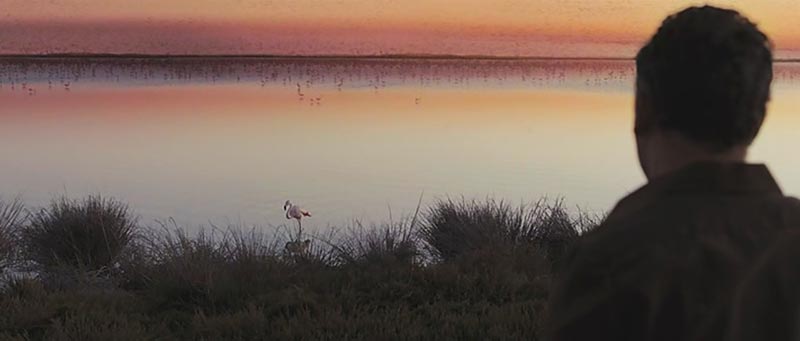
Visually, this Southern Spanish Gothic-cum-neo-noir is stunning, beautifully shot with some breath-taking views courtesy of Alex Catalan’s cinematography. The drone-captured aerial shots, while not a particularly new technique of late, are fantastic; the opening montage resembling both brain and ocular cavity, as if the land itself is an additional character. The use of colour is wonderful, the flamingo scene stunning. Rural Andalucía brings to mind South Korea’s Memories of Murder, Argentina’s Everybody Has a Plan, and even the US’ The Texas Killing Fields and certainly the tone and colour – as well as subject matter – does lend itself to these films and builds an atmosphere which becomes specifically gripping during the final sequence. There is even a supernatural element which aids the noirish and gothic feel to the whole insular, albeit, conventional plot. Misogyny and machismo are at odds just as democracy and the Franco era which still lurks in the background.
The male leads are outstanding, even Goya-winning in the case of Gutiérrez, they are not necessarily complex but at least they have activity to see them through the plot, which sadly, cannot be said for most of the females in the diegesis. There is a severe lack of characters beyond victims, not all are named and almost all either cry or die. Yes, this is an eighties set film and, as previously stated, there is an authenticity to it but a little character development would not have gone amiss, although given the parallels of the 80s and the world today (economic crisis, social tension, inherent sexism), perhaps, it is purposefully done. The slightest of niggles aside; it really is an enthralling watch which unfolds amid beautiful aesthetics.
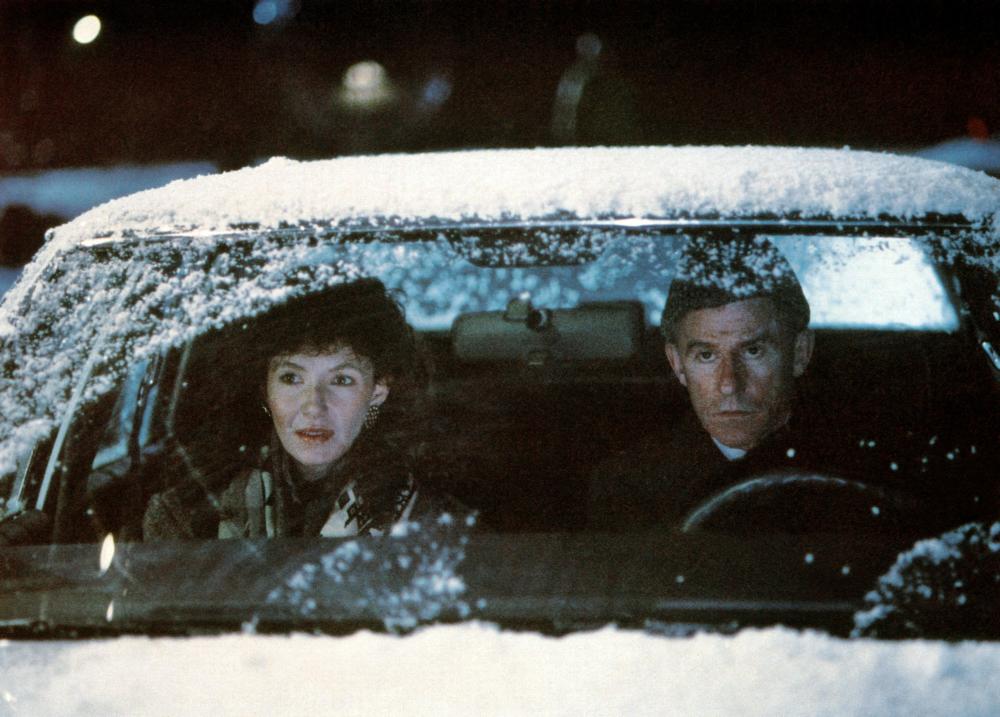
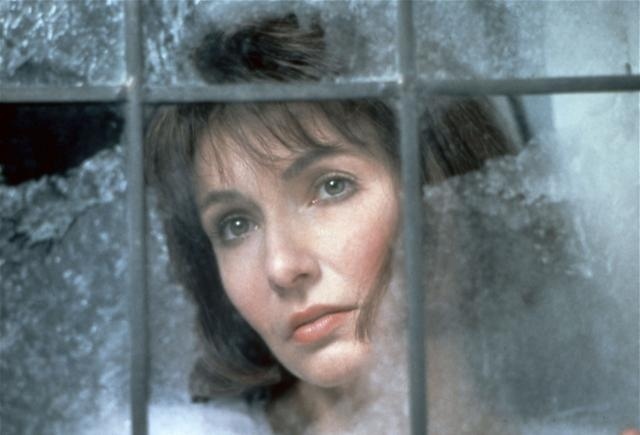
On a snowy, freezing cold night, a woman walks into St. Clair Avenue station and heads towards the line of lockers on the far wall. She walks past twin girls in blue, opens up locker 214 and a grabs a brown leather bag full of money. The audience never sees the woman’s face but her clothing – wide-brimmed hat, mackintosh – all with a splash of red hint at noir while the score screams giallo. Dead of Winter is one of those films that is hard to categorise; part drama, part slasher with a pinch of psychological thriller thrown. Wherever it lies one can, at the very least, argue that it is Arthur Penn’s (yes, that one) attempt at gothic horror.
Loosely based on the Joseph H. Lewis’ noir My Name is Julia Ross (1943), even using the director’s name for Jan Rubes’ character. It is a Freudian’s dream given the numerous nods; from the uncanny, doppelgänger, castrated man, psychologist – everything is to be read and is all, well, very obvious. Rubes’ performance is fairly monotonous, McDowell is a little over-the-top and mediocre; only Steenburgen has work to do and is fairly convincing as three different characters. She conveys a real fragility as Kate McGovern, the actress holed up in a mansion with the two men for a screen test.
There is some suspense to the film, however – while it is well-made – it is a largely televisual affair (even some curse-word dubbing still prevalent in this cut) with some real inexplicable moments which definitely throws up questions. An audience will never guess the outcome in a month of Sundays but by the time it wraps up it has bordered on the absurd and the payoff is not actually worth it.
The music, sound, and red motif are nice touches and certainly enhances Penn’s mise-en-scène, and the wintery backdrop serves the film well but it has a misjudged feel about the whole thing, like Penn has thrown everything cliché, motif and dodgy middling histrionic at it.
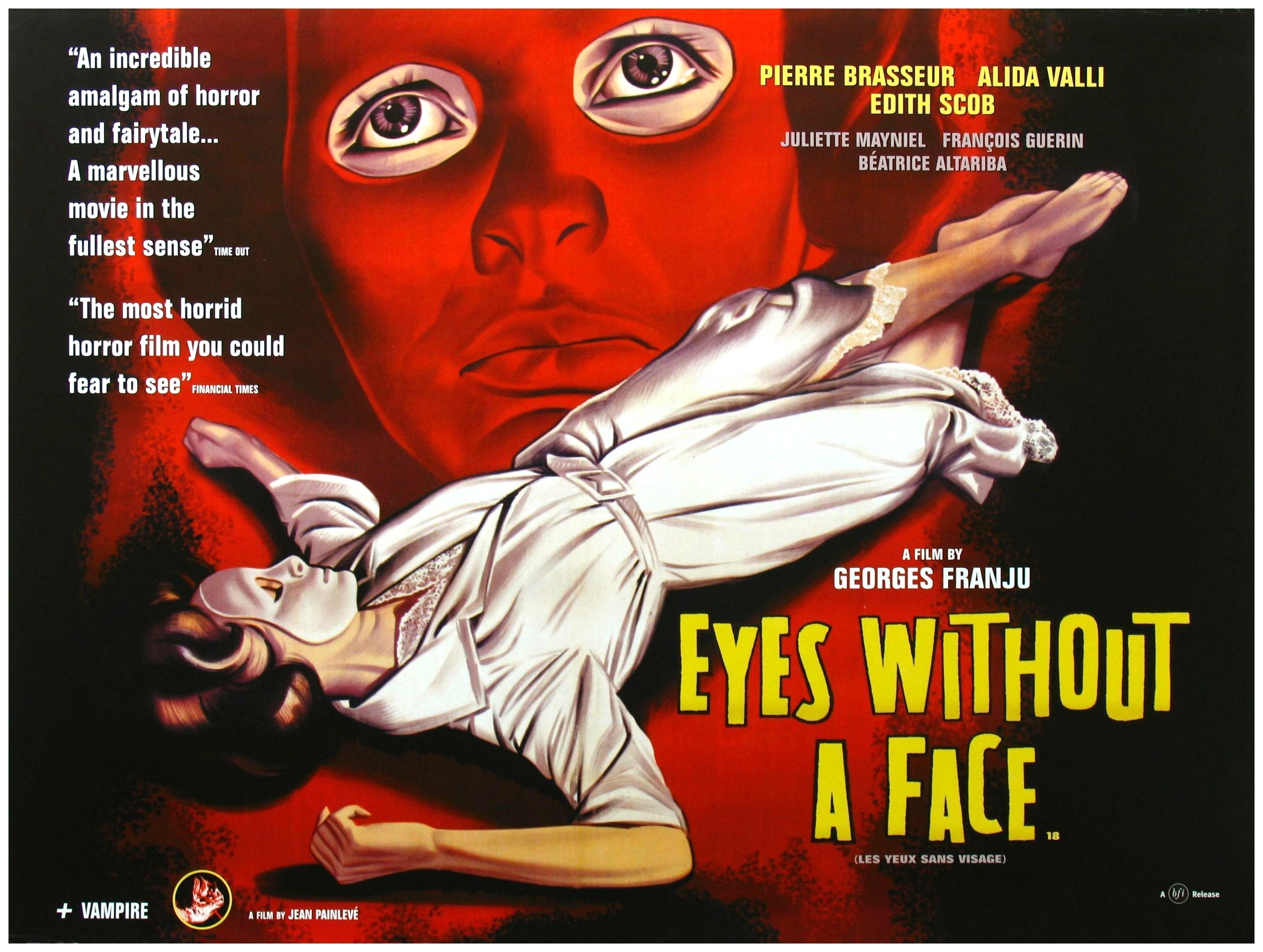
Georges Franju has a thing for masks. Both figurative ones and literal ones are dotted throughout his work, most notably in Thérèse Desqueroux (1962), Judex (1963) and Nuits rouges (1974). However, it is in his 1960 work Eyes Without a Face (Les yeux sans visage) that the literal mask plays a more prevalent role.
The BFI has lovingly restored the film and crafted a plethora of extras to release it on Blu-ray for the first time in the UK and it doesn’t disappoint. Picture quality is outstanding and the sound perfect. The film opens with Maurice Jarre’s carnivalesque, jaunty yet haunting score as a female (The Third Man’s Alida Valli) manoeuvres her car down dark winding country roads at night; the tension building as a person in a mackintosh and hat sits in the backseat. Something is not quite right and all unease is confirmed when the driver hoists the body from the backseat and dumps it into the local river. Louise works for Docteur Génessier (Pierre Brasseur) a prominent scientist and researcher in facial reconstruction, the viability of living tissue grafts and necrosis – the operation scenes of which are horrific thanks to Georges Klein’s make-up and Charles-Henri Assola’s special effects. The police have their suspicions about the good doctor but fail to act before the film’s climatic denouement.
Inside the Doctor’s home, silence is juxtaposed with the tweeting of birds and barking of dogs. It is eerie and foreboding, shot with low camera angles and a static camera is interspersed with the odd tracking shot. The use of chiaroscuro is stunning and shadows add to the atmosphere of the allegorical fairy tale. Darkness gives way to light the higher the stairs climbed until the bedroom of Christiane (Edith Scob) is reached. The camera work and lighting design is a real testament to Eugen Schüfftan’s cinematography. Director of Photography Schüfftan had previously worked with Lang, Siodmak, Ophüls and Pabst and had a three dimensional way of lighting a scene, alternating each first and third shot which is great for adding atmosphere, angst and anticipation.
Christiane appears to be a young girl in her white room but the deep velvety tones of a woman amid the caged doves cooing is a real surprise; an adult prisoner being harder to subdue. Two mandolins hang above her bed arranged like a butterfly; she is in a chrysalis awaiting transformation after a car accident causes facial disfigurement. Forever incarcerated in the old dark house of creaking doors and balustrades of the staircase casting bar-like shadows on the wall, all mirrors are covered and Christiane is forced to wear a mask. A mask of brilliant white frozen beauty that only allows the eyes to be visible and they are the windows to a tortured lonely soul. After a while we forget it’s a mask, it’s gentle and soothing, the fact that Scob glides within each scene makes her appear as if an apparition or marionette doll. She is the caged dove, the constant reminder of her father’s guilt and the feeder of his hubris.
Eyes Without a Face is Franju’s masterpiece, an austere and elegant horror-based fairy tale. It deals with scientific ethics, solitude and loneliness; never has human torture been so romanticised, so cruel, tender and lyrical. Edith Scob, perhaps it is fair to say one-time muse of director Franju having worked with him on five pictures, is the star. She provides such a nuanced almost delicate (yet powerful) performance, her Christiane is as beautiful as she is strange, objectified beyond expression. Well, almost…
Notoriously incongruous, Franju is quoted as saying he subscribed to images and “my images are my fleurs maladives [evil flowers]”. Eyes Without a Face is one evil flower that all must see, at least once in their lifetime.
Arrow Video’s new restoration of David Cronenberg’s Videodrome (1983) follows in the footsteps of Rabid (1977) and Shivers (1975) also restored and re-released on dual format this year. Each film with its disc-filled extras is clearly a labour of love.
Just preceding the Video Nasties Act of 1984, Videodrome, I’m sure would have gotten Mary Whitehouse’s knickers in a twist with the film’s provocative, paranoiac and altogether pleasure-seeking premise. The narrative centres on Civic TV executive Max Renn (James Woods) and his quest to find the next ‘big thing’ in sensationalist programming. His station is responsible for “soft core pornography and hard core violence” which Renn unapologetically justifies as a result of economics. Moral questions arise surrounding the over-stimulation of the consumer following exposure to dehumanising images via the media. These questions are depicted through metaphor, potential Freudian imagery and the former protégé of Dick Smith, multi-Oscar winning make-up effects Wizard Rick Baker (Smith famously created the exploding head in Scanners). Fellow Canadian, composer Howard Shore, yet again, provides the score (Shore and Cronenberg have worked together on all but The Dead Zone) and employs the use of a Synclavier II synthesiser alongside an orchestra. This electronic sound adds a dark, ominous, even metallic, tone to the film and aids with the 80s nostalgia along with the coiffed hair, shoulder pads and leather ties.
Renn stumbles upon Videodrome – a pirate television station which depicts the torture, brutality and eventual death of its subjects. Becoming obsessive to continually transgress social boundaries, Renn shows the footage to his girlfriend Nicki Brand (a hypnotic Deborah Harry) who, by her own admission, is the perfect over-stimulated test audience. She is sexually free (connoted by her costume, both cut and colour) and is immediately enamoured at the premise of the snuff sequences. Her enthusiasm for all things dark and painful grows and she even disappears to audition in Pittsburgh upon hearing the show is filmed there. Left alone, Max begins to suffer hallucinations; disturbing, intriguing visions which only seek to feed his need to consume the morally ambivalent visual media and further blur the line between fantasy and reality. His interactions with the Marshall McLuhan-inspired Brian O’Blivion (velvet-voiced Jack Creley, only ever visible via a television screen) increase the bizarre especially when we learn O’Blivion’s history to Videodrome. It is an aesthetically pleasurable film; body parts are fetishised, Betamax tapes pulsate and television undulate and literally swallow the flesh.
Anybody familiar with the articulately intense septuagenarian director will immediately recognise the body consciousness which is prevalent in a large percentage of his oeuvre. The man, who has cited Bergman, Fellini and Kurosawa as main inspirations, presents the limitations of the human body within his own artistic nihilism. Ideologies are often invasive and monstrous, the embodied becomes disembodied whilst sex and violence surrounds, causes, or indeed invades the diegesis. There can be contradictory readings of Cronenberg’s films; does he fight for the patriarchal pleasures he depicts and stray dangerously close to misogyny or destroy said pleasures while reinforcing the fragility of the physical body and mind? While the male consciousness is seen in crisis and at odds with the social world around him, it is the female body which appears abject and the site of disgust. In Videodrome, the male mind becomes more abhorrent through feminine imagery; Renn’s torso is repeatedly violated via the vagina-like opening. Or perhaps, it is like the man himself stated a few years ago; he plugs into the zeitgeist, examines and plays around with it. In simple terms Cronenberg’s films are about life and death yet he cleverly uses the horror and prosthetics as a distancing tactic. He questions who or what we are and presents, albeit through social paranoia and viscera, the evolutionary limitations of the human body and the emotional terror of the waking nightmare.
Videodrome has never been more relevant in the face of the current media and image appropriation. It is disorientating, visually audacious and presents an ideology which is fascinating, wholly original but is, perhaps, one of the more convoluted Cronenbergs. That said, as a first time viewer (yes, I know…) the experience of it was exhilarating.
Blu-ray Extras
Never one to scrimp on material, Arrow has collected an array of goodies and following the film, there are numerous options for the viewer to take, although do yourself a favour and hit them all.
Cinema of the Extreme – The 1997 BBC documentary featuring Repo Man director, Alex Cox, David Cronenberg and George A. Romero briefly discuss cinema extremes. These verbal tidbits are intercut with clips of Shivers, Dawn of the Dead (1978) Videodrome and Crash (1996). It is a slight, fairly insignificant documentary which never goes into great detail but Cronenberg’s thoughts on censorship are always worth a listen (Cox’s on Seven, not so much).
Forging the New Flesh – Visual Effects artist Michael Lennick narrates (and stars) in the first of his four contributions to these extras and discusses the techniques used in the making of the film. This, unfortunately, short but fascinating featurette contains behind-the-scenes footage and interviews Rick Baker, Bill Sturgeon, David Cronenberg and star James Woods.
Fear on Film – One of the highlights of the disc extras is a roundtable discussion originally aired in 1982; presented by Mick Garris and featuring David Cronenberg, John Carpenter and John Landis in tweed, flared jeans and big hair respectively. The conversation centres around the horror genre, what scares the filmmakers, films, as well as their individual takes on censorship and ratings. Although, less than 30 mins long, it is a highly entertaining and lively chat and well worth watching.
Samurai Dreams – The complete and uncensored Japanese series Samurai Dreams with optional commentary by Michael Lennick who is still revelling in the Videodrome/Samurai Dreams experience some 32 years later.
Helmet Camera Test / Why Betamax? – Bite-sized early test footage showing Max Renn’s virtual hallucination chamber head-gear and a second segment which very briefly details why Betamax was the format of choice.
Promotional Featurette – This is an extension of Forging the New Flesh documentary although written and directed by Mick Garris and features behind-the-scenes footage and the making of Videodrome. Interviews include: Cronenberg, Harry and Woods As with the previous featurettes, these are brief but still interesting.
Audio Commentary is provided by author Tim Lucas (Videodrome: Studies in the Horror Film).
Cronenberg: Early Works Blu-ray
Transfer of the Future – The ever entertaining and jovial Kim Newman discusses, examines and critiques Cronenberg’s early career and labels him a child of Romero and genre auteur along with fellow underground directors Brian De Palma and Tobe Hooper.
The Early Works – Restored by the Toronto Film Festival, Criterion Collection and Arrow Films respectively, these films show the progression of Cronenberg as an art student and his shorts through to the first feature film which was made some five years before Shivers.
Transfer (1966)
From the Drain (1967)
Stereo (1969)
Crimes of the Future (1970)
In Transfer, shot on a snowy Canadian landscape, an analyst (Mort Ritts) and his patient Ralph (Rafe McPherson) thrash out their doctor/patient relationship via farce and Freudian speak; while in From the Drain, two men (Mort Ritts and Stephen Nosko), seemingly war veterans sit clothed in a bathtub awaiting something ominous which may or may not come out of the drain. Stereo was the first short feature film shot on 35mm and has an establishing shot reminiscent of Fellini’s La Dolce Vita (1960) and appears to be heavily influenced by Bergman. It stars Ronald Mlodzik (later seen in Shivers and Rabid) whose costume looks deliciously Hammer-House-of-Horror-like. This is the best of the bunch, definitely my favourite; shot in black-and-white, silent save for a voiceover, the canted camera angles add to the general creepiness and sterility of the sanatorium set amidst the Ontario north woods. Subjects are placed in isolation and operated on, telepathic ability and extra sensory perception is monitored through sexual interaction. Finally, the last feature is Crimes of the Future a potential follow-up to the preceding film. Restored exclusively by Arrow Films from a new 4k scan of the original 35mm negative, again starring Mlodzik (as Adrian Tripod), and again silent but for the added commentary, only this time in colour. In the House of Skin all women are extinct and Tripod is in search of the enigmatically named Antoine Rouge.
It is fascinating to see the early attempts of an artist, to witness how he develops and to note his visual interests and motifs even back then. There’s the Freudian terminology (which all eventually came to a head in A Dangerous Method [2012]), themes of consciousness, sexual experimentation, telepathy and the oddly monikered characters which have all been seen over the Cronenberg oeuvre at one time or another. They may not, necessarily, be to everybody’s taste but they are revelatory in their style, content and deserve to be seen in all of their restored loveliness. All-in-all, Arrow has produced a beautiful box set which cannot be recommend highly enough.








 The Framing Device