Categories
Article

(Wo)man of Steel

wwface
carcassonne_by_yalestewart-d5myftz

The much anticipated Superman reboot has opened in cinemas (last week for those of you holidaying on Krypton) and yes, for the most part, it is pretty good and yes, it is all the Twitterverse can tweet about or so it has seemed since opening weekend. It is now time to move on and consider DC’s next move. Man of Steel’s success, hot on the heels of The Dark Knight, has meant talks of a Justice League of America movie, for those of you not in the know The JLA is to DC what The Avengers are to Marvel. It is only logical (and fair) that the third major player in the League, and indeed the DC Universe, gets their stand alone origin film. I am, of course referring to Wonder Woman.
ww-40s

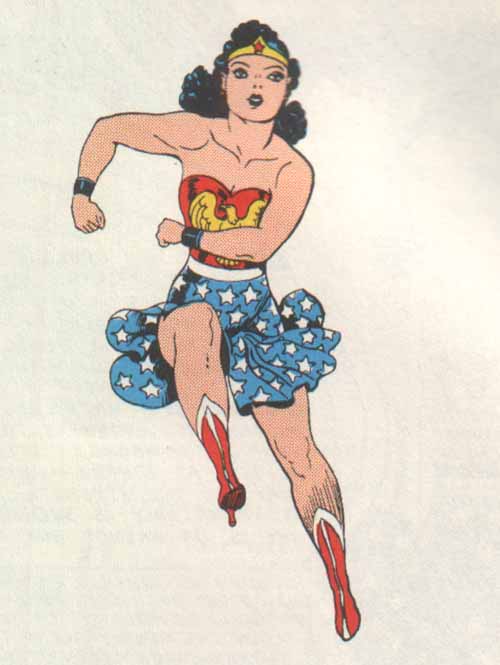
Created in 1941 – following Superman in ’38 and Batman in ’39 – by William Moulton Marston, in part, for the following reason:

“Not even girls want to be girls so long as our feminine archetype lacks force, strength, and power […] they don’t want to be tender, submissive, peace-loving as good women are. Women’s strong qualities have become despised because of their weaknesses. The obvious remedy [was] to create a feminine character with the strength of Superman plus all the allure of a good and beautiful woman.” (WMM, 1943)

Erm, okay William…”tender, submissive, peace-loving [weak] as good women are…” . I will, however, on this occasion ignore the slight stench of misogyny and gross misrepresentation of women in this reasoning, on the basis that you created my favourite superhero (I idolise all the other guys too but there is a special place in my heart for WW) and I think the important sentence in this statement is “with the strength of Superman” because she is just as tough; the woman of steel.

wonderwoman3

We all know female superheroes are somewhat scarce, not necessarily on the comic-book page but certainly onscreen (and no, Jean Grey and a foul-mouthed eleven year old do not count, at least not for me), conceivably, a product of their time or maybe too many females transgressing the boundaries of the norm would encourage women wanting to be women – Gloria Steinem has written several essays on the Amazonian, attesting to the strength and influence of the feminine archetype. Perhaps, in spite of Joss Whedon’s utter condemnation of the notion that men aren’t interested in the exploits of female she-roes, there is actually some truth in it. Who wouldn’t want to see the strength and power of Gaea, the hunting skills of Artemis, the wisdom of Athena, the speed of Hermes and the beauty of Aphrodite personified in the intelligent, honest and disarming charm of Diana Prince?

doranww - Copy

Dressed in the red, white and blue standard of freedom and democracy – Batman isn’t the only one with an arsenal of goodies – she wears a tiara which is razor-sharp and can be hurled like a boomerang, her bracelets worn at the wrist can deflect bullets and serve as a reminder of the shackles once worn when the Amazons were the prisoners of Ares. She carries Hestia’s golden Lasso of Truth; tiny chain-links with limitless length, indestructibility and of course, anybody bound in it are compelled to tell the truth. Wonder Woman does have the ability to fly (although not soar high), can spin at blurring speed, usually to shed her civvies, is able to communicate with most animals and beasts and has numerous vehicles at her disposal, all invisible. Like I said, she’s just as physically strong and special as Supes. Their similarities are actually hard to ignore: they are both on Earth, separated from their familial roots, both have an alias to protect and while they don’t fully comprehend the planet they inhabit they wish to shield and, wherever possible, save the humans living on it, and still she has not been immortalised on the big screen, yet Superman’s genesis gets regurgitated every decade or so.

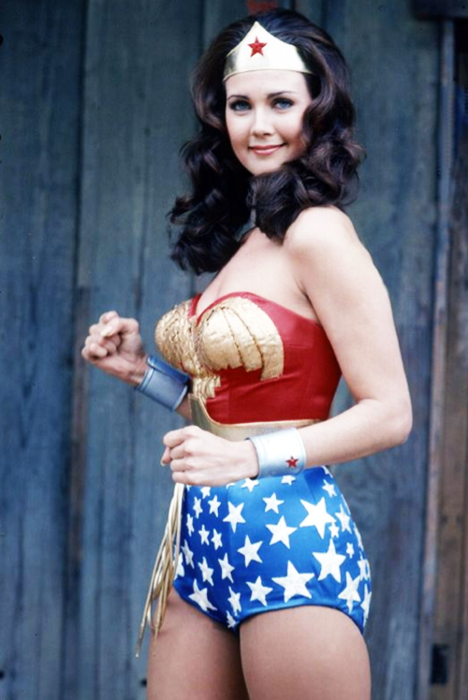
There is the (now) kitsch and fabulously camp television series made in the 70s which ran for three seasons and saw former Miss USA, Lynda Carter don the girdle and fight for our rights in satin tights. She was wonderful in it; strong, fearless, savvy, intelligent and beautiful, a Goddess on Earth instilling hope and convincing the world of compassion, humility and generosity – all the while kicking ass. Carter is 61 now and will forever be a Wonder Woman but it’s time for a change, the character needs to be brought into the twenty-first century. David E. Kelley did attempt it in 2011 with Adrianne Palicki in the titular role, Elizabeth Hurley as the villain, along with a supporting cast that included Cary Elwes and Tracie Thoms. His pilot was never optioned probably down to the horrible SFX and the fact that he portrayed the beautiful peace-loving princess as a sexually frustrated spinster who curls up in front of The Notebook, or obsesses over a Facebook page when she’s not ripping out people’s throats – as soon as Diana pulls out the merchandise and dolls, it all gets a little too meta.
Wonder Woman2

Wonder Woman is, in the words of Lynda Carter, “the beautiful, unafraid, tenacious and powerful woman we know resides within us [even you boys], the antithesis of victim […] a symbol of extraordinary possibilities that inhabits us, hidden though they may be.” Last year, I saw a billionaire playboy take to the sky dressed as a giant bat, last week I witnessed a super alien male don a red cape and protect a city. I don’t see how watching an Amazonian Warrior wearing a tiara, star-spangled shorts and attempting to educate mankind is any different. It is time for the Wonder Woman to have a go at saving the world.
Categories
Blu-ray film review

Beyond the Hills (Dir. Cristian Mungiu, 2012)

Damnant quod non intellegunt*

beyondthehills7900x506

Beyond the Hills is Cristian Mungiu’s follow up to 4 Months, 3 Weeks and 2 Days which won the coveted Palme d’Or in 2007 and once again, the director utilises the close friendship of two female protagonists to comment upon gender and politics influenced by Communism and its chokehold on Romanian society. While political and sexual repressions were depicted through the gamut of illegal abortion, here it is commented upon through an organised religious sect.

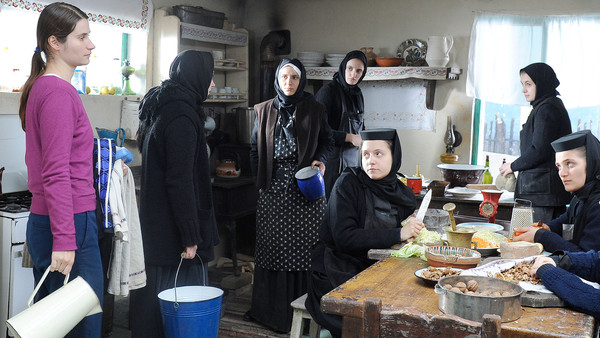
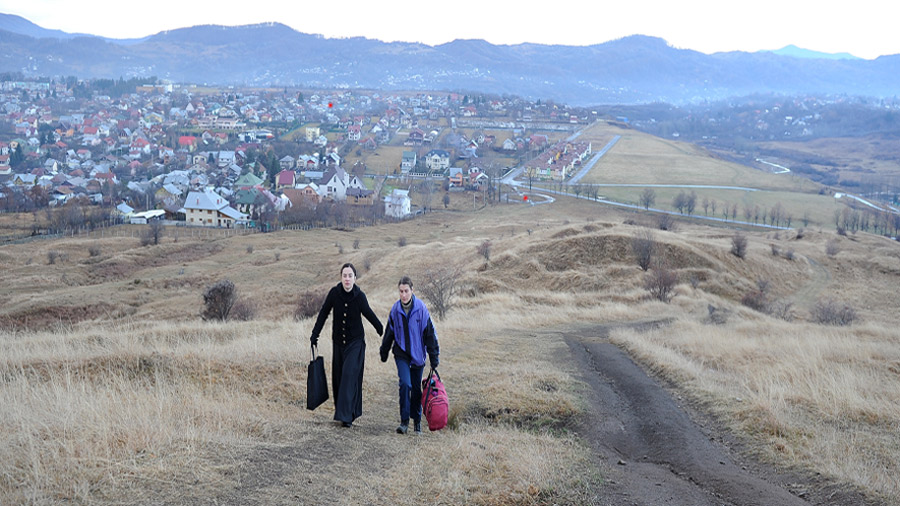
Volchita (Cosmina Stratan) and Alina (Cristina Flutur) are young women in their twenties, having grown up together in an orphanage. They have a familial bond tied by history and circumstance rather than blood; the true nature of their relationship is hinted at yet remains somewhat ambiguous throughout. Alina returns from Germany, where she now works, for a few days – a holiday – expectant that Volchita will return with her. Instead, she finds her friend living in a Monastery deep in the Romanian hills, literally hidden from civilisation embedded in an austere, archaic landscape. Volchita is confined to the bosom of Nuns who cohabit under the strict patriarchal, authoritarian rule of ‘Father’ (Valeriu Anchuta). The devout community stands alone next to an unconsecrated Church which houses a small congregation on a holy day. A sign on the front gate reads, “This is the house of God, forbidden to anybody of a different religion. Believe and don’t doubt”, the irony of which is not lost on the viewer especially once learning of the idolatrous and essentially, sacrilegious existence of this ‘House of God’. It is interesting and somewhat staggering to note that nearly 86% of the Romanian population practises the Orthodox faith, despite the fact that the country has no state religion but then, this film is not preoccupied with religious institution, at least not completely.

beyond

Mungiu’s third feature is a love story of sorts, faith at its very heart; belief in State, family and in a God which remains largely silent. It is a film about exorcism/possession, one situated outside of the confines of genre conventions and misogynistic dictatorship which is set on suppressing sinners who also happen to be women. The population outside is at a distance. You would be forgiven for thinking of it as a historical drama, the community is frozen in time, isolated, amid a lack of running water and electricity, save for Alina and her contemporary clothes. She is often the only splash of colour in an otherwise dark, dismal, and sombre mise-en-scène. She is a symbol of the outside world threatening to upset and challenge the religious conservatism and totalitarianism that appear to have engulfed Volchita.

The film is beautifully shot, blue and grey hued washes are abundant across the breathtaking landscape always captured in long shot, adding, not only, to its beauty but also educing the notion of freedom especially when juxtaposed with the interior medium shots. All employ, long takes, deep focus and are tightly framed which feeds the claustrophobic and repressive nature of the Monastery, exacerbating the tension between the religious and secular dichotomy and, in addition, the verisimilar style of storytelling Mungiu and his Romanian New Wave contemporaries adopt.

Beyond the Hills is deliberately paced to show the mundanity of life and natural flow of time. It is an enthralling and chilling commentary on traditionalism, irrationality of society and humanity at its most flawed. By its conclusion, which takes a jolting twist, all are accountable and yet there is no obvious villain. The final shot will resonate for a long time after the film has finished, once again, proving Mungiu as a director of merit, one who can coax astonishing performances from his leading actors and I know I, for one, will be awaiting his next contribution with bated breath.

*They condemn what they don’t understand

Categories
DVD film review

Texas Chainsaw (Dir: John Luessenhop, 2013)

No Massacre, No Substance

Texas-Chainsaw

The old adage, “you can never have too much of a good thing” would appear to be the mantra of Hollywood horror producers – excellence being sporadic and fleeting. Friday the 13th tops the list of saturated horror franchises with twelve movies, followed by Halloween with ten and then there are the seven Saws. The next dire instalment of mediocrity is probably not too far behind.

Leatherface

It has been thirty-nine years since Tobe Hooper’s seminal family horror, The Texas Chain Saw Massacre (1974) and over the years viewers have been party to sequels, new generations, prequels and  remakes – “Chain Saw Massacre” became “Chainsaw Massacre” and then no “Massacre” at all – none of which have even come close to the first. Part of what made Hooper’s original so influential was its stark cinematography, verisimilitude and its “true story” marketing (based loosely on the exploits of real-life serial killer Ed Gein) with a documentary-style voiceover and photographic stills filmed on 16mm. Its narrative and plot were, of course, entirely fictional but the finished film serves as a subtle commentary on the political climate and symptomatic of the era; something of worth created within budgetary constraints. The US was still knee-deep in the Vietnam War and this affecting horror visualised an apocalyptic landscape, sparse and abandoned through industrial capitalism (Robin Wood). It depicted a non-traditional, perhaps arguably degenerate, familial homestead transgressing the boundaries of the norm and surviving via cannibalistic insanity. As a movie, it stays with you long after viewing and its esteemed standing in the horror genre a testament to director Hooper and writer Kim Henkel, who created an influential piece of frightening art in spite of a profound lack of blood, guts and gore.

1-Texas-Chainsaw-3D(1)

A whole decade has passed since Marcus Nispel’s futile remake starring Jessica Biel and seven years since …The Beginning which tried to explain away all elements which made the original so groundbreaking and yet still the unnecessary franchise additions keep coming. The latest attempt, Texas Chainsaw is released on DVD from the 27 May 2013 through LionsGate. The film begins moments after the 1974 release and condenses its pioneer into a few short frames culminating in Sally Hardesty’s (Marilyn Burns) bloodied and hysterical escape. A Hatfield and McCoy type battle ensues between the Sawyers and Hartmans which leaves the old farmhouse burned to the ground, several members of each party dead and a small child ripped from the arms of her mother. Flashforward to present day and Heather Miller (Percy Jackson’s Alexandra Daddario) learns of her adoption and her biological grandmother Verna who has left her a significant inheritance. She jumps into a Volkswagen with her boyfriend Ryan (Tremaine ‘Trey Songz’ Neverson) and friends Nikki (Tania Raymonde) and Kenny (Keram Malicki-Sanchez) to learn her true identity. They pick up a drifter along the way in the form of Darryl (Shawn Sipos) and arrive in Texas to revel in her new-found wealth and meet her birth family, of which there is only one surviving member.

alexdtc

Regurgitating elements of horror films including Psycho (1960), Halloween (1978) The Funhouse (1981), I Know What You Did Last Summer (1997) (there’s even a cheesy nod to Saw), this film lacks any of the originality, atmosphere, zeal or purpose of those previously mentioned. Its director John Luessenhop has, by his own admission, never directed horror before and it shows. He has attempted to make a film comprising mainly of replicated shots, imitating but never matching the original source material. The mise-en-scène is coaxed to the point of contrivance, resulting in no scares and making for dull, and insulting, viewing especially for a fan of the genre. The decision to discount the franchise instalments which have been made since ’74 is certainly an interesting one from writers Debra Sullivan, Adam Marcus and Kristen Elms, especially in the introduction of the extended Sawyer clan (the Sawyer family name was not introduced until the 1986 sequel).

Unfortunately, this lack of research and attention to detail is evident throughout the 90 minutes and, for a film selling itself as a saga continuation, is problematic. There is an attempt to humanise the psychopath to almost Frankensteinian level asking the audience to illicit empathy for a character that back in the day was motiveless and incapable of remorse and one who should be close to retirement age by now. The recurring motif of meat has all but been removed, here “flesh” obviously connoted through its Abercrombie-&-Fitch-alike cast of characters, all of whom are underdeveloped, and a leading lady who blatantly and irritatingly defies the timeline the writers and director are attempting to evoke. Throw in a few derivative proverbs regaling family, highlight vigilantism and have at least three cameo appearances that only draw attention to the shortcomings and you have got yourself a wholly atrocious and (un)bloody waste of time.

Categories
film review

Behind the Candelabra (Dir. Steven Soderbergh, 2013)

Liberace.JPG

Upon hearing the news regarding Steven Soderbergh’s ‘retirement’ I, like a lot of the movie-going public, flocked to see Side Effects (2013) and was left utterly disappointed. For me Haywire (2011), Magic Mike (2012) and the afore-mentioned have not been, well, particularly good. However, any reluctance I felt about Behind the Candelabra quickly dissipated upon reading reviews from Cannes and seeing the odd TV spot/trailer – also general curiosity is hard to ignore.

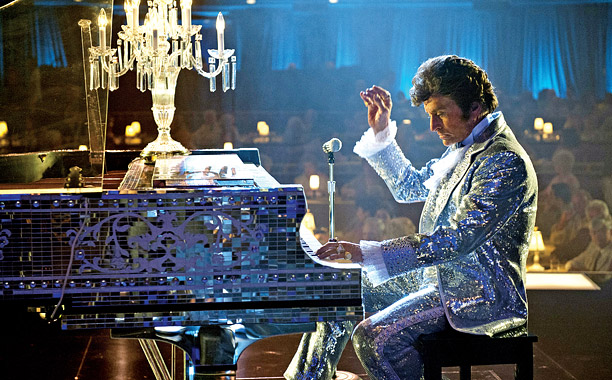
The film is based upon the memoir Behind the Candelabra: My Life with Liberace by Scott Thorson, which recounts the tempestuous six year relationship between the blonde, animal handler Thorson and the pianist extraordinaire and showman, Liberace. The candelabra referring to the sparklingly opulent piece of tableware Liberace always had placed upon his piano. The interesting thing about the candle tree is that, literally, you cannot actually hide behind it, but arguably be seen through it, part of your features hidden from view. Soderbergh attempts to show the viewer what is behind it, a glimpse of a man who insisted on hiding his sexuality from view. Unable to secure a major Hollywood studio to back the film, the director believed that studio rejection was down to it being ‘too gay’, thankfully, HBO stepped into the breach and produced this biopic. As a result, there will be no cinema release in the States and any accolades that Douglas could be nominated, or indeed deserve, for his portrayal of the flamboyant entertainer, are limited to Europe.

michael-douglas-matt-damon-behind_the_candelabra-01

It is 1977 and the opening scene introduces the viewer to Thorson (Matt Damon) and his simple lifestyle working with animals and living with his Foster parents Rose and Joe Carracappa (Jane Morris and Garrett M. Brown) on a ranch in California. He is picked up in a bar by Bob Black (Scott Bakula) who, upon next meeting, flies the teenager to Vegas to meet ‘Lee’. Thorson quickly finds himself in a relationship with the much older, closeted, devout Catholic star. Spanning ten years, each year displayed upon an intertitle, Scott and Lee’s six-year relationship is very much a give-and-take kind of liaison; Liberace heaps wealth, in the form of gold and diamond jewellery, clothes, cars and a fixed abode in one of the most ostentatious surroundings, and Scott gives him what he needs in the bedroom. The pianist lived the life he chose, believing that ‘too much of a good thing is wonderful’. He, on countless occasions, denied his homosexuality and swiftly sued any tabloid/journalist who reported otherwise. The man purported on screen is one not completely removed from the lovable, warm, smiley entertainer the world seems to remember – perhaps a little darker. There is no denying the attraction to young men, however, the lonely star appeared to want a lover, friend, and son in Thorson and during one bizarre sequence ‘Lee’ and Scott meet with a lawyer to discuss the adoption process.

thorson

Their idyll becomes too comfortable with both surrendering to food during their extended ‘love-in’ and upon seeing himself on the Johnny Carson show, Liberace declares that he can no longer look so old. He enlists the surgical expertise of Dr Jack Startz (a ridiculous-looking Rob Lowe) and has a full face-lift, eye-lift…the whole shebang – the only side effect being that he cannot close his eyes, even when sleeping. Startz also sets out to recreate Scott too, into a young Liberace, complete with chin and cheek implants. The doctor then prescribes diet pills and Thorson’s spiralling unhappiness and claustrophobia from the reclusive living environment develops into an addiction with the ‘California Diet’ pills making way for cocaine. This then sees Scott sell off his possessions one by one, in order to support his increasing habit. Scott’s despondency, drug-induced mood swings and struggling with the concept of monogamy, Liberace begins to shut his lover out and they begin fighting amid jealous recriminations. It all comes to a head when Rose dies and Liberace insists on flying Scott home for his foster mother’s funeral. Upon return, Lee has already moved in Scott’s replacement and so begins a bitter battle when Scott attempts to sue for palimony – their life together, he insists, was a marriage.

In his first role since his cancer remission, Michael Douglas’ star has never shone quite so bright – not since Falling Down (1993, dir. Joel Schumacher) and Wonder Boys (2000, dir. Curtis Hanson) has he owned the screen in quite the same way – in fact, he is incandescent, sequins and glittering diamonds aside. It is hard to reconcile the virile, ladies man of the 80s and 90s, with this role; I would go as far as to say that this was the role he was born to play. Damon is, as ever, a strong presence as Thorson and the supporting cast including Debbie Reynolds as mother (Frances) Liberace, and Dan Aykroyd as Lee’s manager Seymour Heller is a joy, complete with a hairpiece to rival the showstopper himself. This feels like an HBO production and yet it still retains the richer, stylistic nuances which are associated with Soderbergh: lighting, colour washes, oblique camerawork and point-of-view. Whether his retirement or sabbatical from filmmaking is true, I am quite content for Behind the Candelabra (especially with that fabulously kitsch, blinging and camp dénouement) to be literally, albeit not technically, my last Soderbergh; at least for the time being.